
Journal · 26 October 2026 · 8 min read
Pooja unit design for Bangalore apartments
Where to place a pooja unit in a flat, the formats that fit, stone bases and warm lighting, flame and smoke safety, and what to ask before you hire.
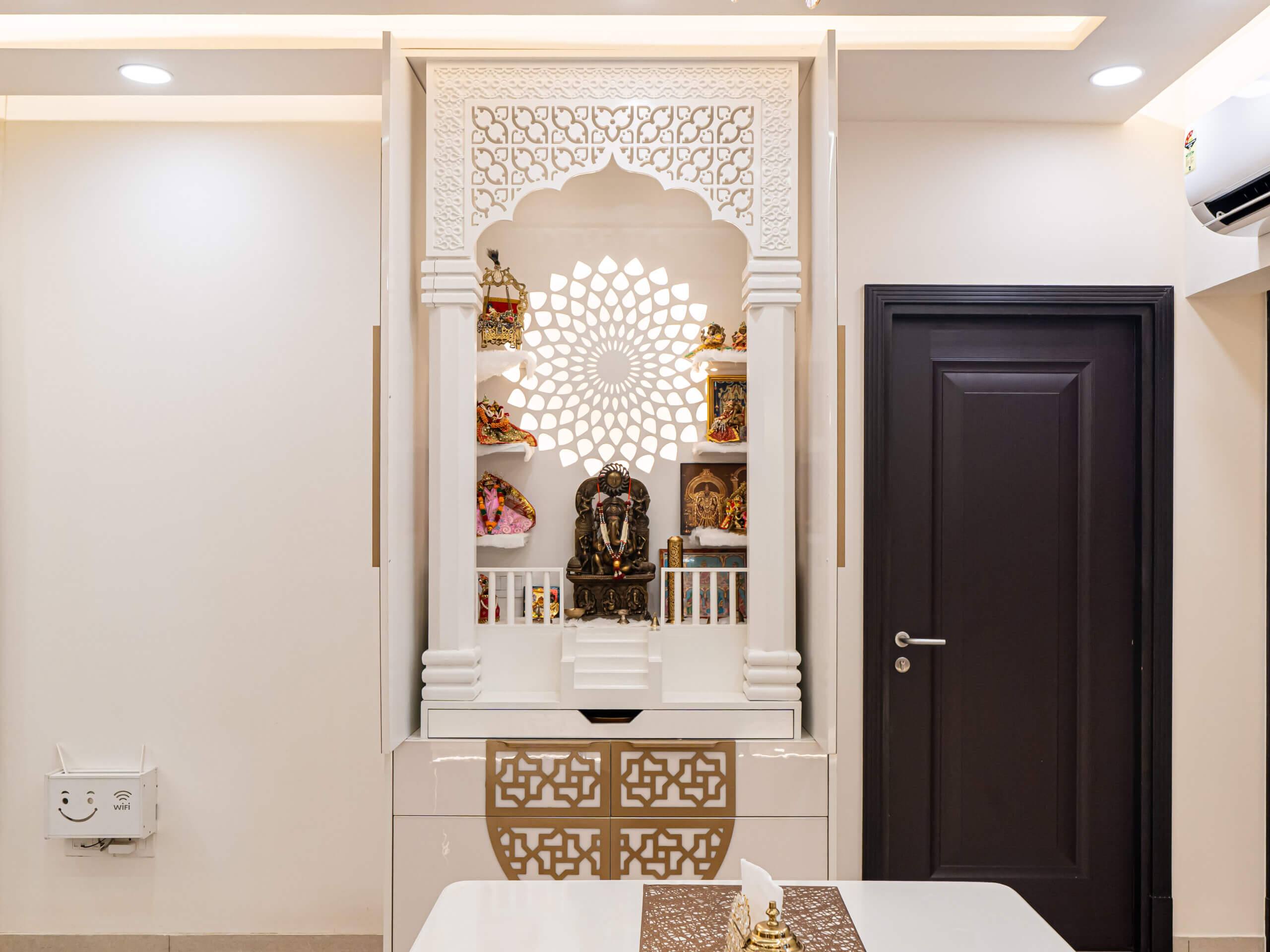
Festival season is around the corner and the new flat looks fine, except for one corner. The idols sit on a borrowed shelf, the agarbatti stand wobbles and the diya is uncomfortably close to the curtain.
For many Bangalore families the pooja space is the heart of the home, yet it is often the last thing anyone plans. Designed properly, it can be calm, safe and sized for a compact apartment. This post covers placement, formats, materials, lighting, safety and the questions to ask before you hire.
Why the pooja space gets squeezed in flats
In older family homes the pooja space had a room of its own, or at least a generous corner. A 2 or 3 BHK in Haralur, Bellandur, Whitefield or HSR Layout has to fit living, dining, work and storage into a compact footprint, and the pooja area is what gives way.
The result is familiar: a shelf above the TV unit, a corner of the dining table, or a readymade mandir from a shop that never quite matches the rest of the house. It works, but it rarely feels peaceful.
A planned pooja space gives the family a clean spot for daily prayer, protects the idols and pooja items, handles flame and smoke safely and looks like it belongs. It does not have to mean heavy carved wood. Clean lines, warm lighting, a carved jaali panel, a marble base and a drawer for pooja items sit comfortably next to a minimalist living room. The unit in the photo above is in a 3 BHK at Sobha Royal Pavilion: a white CNC-cut jaali canopy, a backlit mandala behind the idols and a patterned cabinet below for storage, on a dining-room wall beside a door.
Where to put it
Placement matters as much as looks. These are the positions we work through with you.
Vastu and direction
Many families prefer the northeast corner of the home, with the person praying facing east or north. If that corner works with your floor plan, good. If it does not, an apartment comes with a fixed layout, and the job is to find the best workable position and explain the trade-offs. If your family follows specific traditions, share them early, and check with your family priest or Vastu consultant before you finalise.
A wall in the living room
The most common choice in flats. A wall-mounted unit or niche on a side wall of the living room is easy to reach, visible and out of the walkway. Keep it away from the TV wall and from walls shared with bathrooms.
The dining area or a passage
A slim unit between the dining space and a passage works as long as it is not on a busy path. Leave standing room for aarti and make sure dining chairs will not block it.
A bedroom in a compact flat
In a 1 BHK a bedroom corner may be the only option. A unit with doors, or even a simple curtain, lets you close it when needed. Keep it away from the foot of the bed.
Spots to avoid
Walls shared with a bathroom, anywhere near the kitchen stove, and anywhere near a heat source. Partly tradition, partly safety and cleanliness.
Four formats that work in apartments
You do not need a large space for a good result.
Wall-mounted cabinet
A floating cabinet fixed to the wall, usually with a shelf for the idols, a drawer below for pooja items and a backlit panel behind. It saves floor space and suits 1, 2 and 3 BHK homes alike. It needs proper wall fixing, especially if you have heavy marble idols.
Freestanding unit with doors
This one reads as a piece of furniture. Doors in fluted glass, wooden louvres or a CNC-cut jaali let you close the space when you want to. A good choice if you have the floor space and want generous storage below.
Niche or alcove
A niche is recessed into a wall or partition and takes almost no floor space. It looks very clean, but it works best when planned early, during the full home design, because it may involve changes to the wall. Structural walls need care.
Compact options for small flats
A corner unit, a shelf inside the TV unit with a sliding door, or a foldable mandir that opens only during prayer. A small space still feels sacred when it is neatly planned.
Materials, finishes and lighting
A marble or granite base belongs under the diya. Wood adds warmth, and solid surface gives a sleek look. Many of the designs we build combine a stone base, a wooden body and brass accents. Soft whites, warm woods and gold details suit contemporary homes. Avoid very glossy finishes, which glare under diya light.
For lighting, use warm white LEDs in the 2700 to 3000 kelvin range: a backlit panel behind the idols and a small spotlight on them. Cool white light makes the space feel like an office, which is the opposite of what you want.
Flame, smoke, storage and weight
A pooja space has to work safely every single day, not just look right. Four things deserve extra attention.
Flame and heat
Diyas, camphor and incense involve open flame. We recommend a stone or tile base under the diya, a clear gap between the flame and any wood or fabric above it, and heat-resistant finishes around it. Keep curtains well away.
Smoke and incense
Agarbatti and camphor smoke lingers, and a closed cabinet traps it. We plan a ventilated top or a jaali back so the smoke has somewhere to go. If your apartment has smoke detectors, keep the unit away from them and check your society’s guidelines.
Storage that hides the clutter
Pooja items multiply: oil bottles, wicks, matches, incense, kumkum, haldi, books, festival decorations, spare idols. Deep drawers with dividers and a closed cabinet below keep everything tidy and within reach.
Weight and fixing
Marble idols and brass lamps are heavy. Shelves need proper support, and a wall-mounted cabinet must be fixed into solid wall, not just plaster. Many Bangalore apartments have lightweight internal walls, so we check the wall type before anything is fixed.
Designing for Bangalore weather and apartment rules
Monsoon humidity
Bangalore’s long monsoon keeps the air damp. Damp air makes ordinary wood swell, tarnishes brass and can leave an incense corner musty. We use BWR or BWP grade ply and moisture-resistant finishes, seal the edges and leave the unit some ventilation so it can breathe. The upside of the mild weather is that you can often keep a window open during prayer.
Society rules
Most apartment communities have rules for interior work: working hours, lift protection, material movement and deposits. Some also restrict drilling and open flame. Check with your society before you finalise the design, and work with someone who has handled these rules before.
Compact spaces
Most Bangalore flats are compact, so the vertical space has to work. Wall-mounted cabinets, niches and corner units free up the floor, and light finishes stop the area feeling heavy. A small pooja space designed with care often feels more peaceful than a large, cluttered one.
Festival and griha pravesh dates
Families often want the pooja space ready before a housewarming, Ugadi, Ganesh Chaturthi, Navaratri or Diwali. If you have a date in mind, say so at the first call, and the design, fabrication and installation are planned backwards from it.
Where to spend and where to save
Spend on proper wall fixing, heat-safe finishes and good lighting. Those are the things you notice every day. Save on decorative extras you can add later: brass bells, extra shelves, festival accessories.
How the work runs, from first call to handover
- Discovery call and site visit. We measure the space and ask about your idols, your rituals and your habits. Do you light a diya every day? How many people pray together?
- Placement and layout. We settle the position, size and format, then check the wall and the wiring.
- 3D design and material selection. You see the pooja space before it exists and pick finishes from real samples.
- Itemised quote and agreement. Materials, brands, timeline and payment stages, all in writing.
- Fabrication. Carpentry, stone work, jaali cutting and electrical work happen in a planned order.
- Installation. The unit is fixed, lit and tested for safety.
- Handover. Every drawer, door and light is checked with you, and snags are fixed.
A custom pooja unit usually takes two to four weeks from design approval, depending on the design, materials and approvals. If it is part of a complete home, it follows the overall schedule, which is typically 45 to 60 working days.
Questions to ask before you hire
Whether you are comparing interior designers or a specialist carpenter, keep these handy for the first meeting.
- Can I see a finished pooja unit, and speak to the family who uses it?
- How do you plan for flame, heat and smoke safety?
- What goes under the diya, and what finish is used around it?
- How will the unit be fixed to my wall, and have you checked the wall type?
- Will the quote be itemised, with materials and lighting listed?
- Who supervises the work, and who do I call if something goes wrong?
- What warranty covers the carpentry, the finish and the lighting?
- Can you finish before my housewarming or festival date?
Good designers answer these calmly and in detail. Vague answers tell you something too.
Common questions
Which direction is best for a pooja unit in an apartment?
Many families prefer the northeast, with the person praying facing east or north. If your layout does not allow it, choose the best workable spot and speak to your family priest or Vastu consultant.
How much space does a pooja corner need?
A compact wall-mounted cabinet works in roughly two feet of width. Leave standing room in front for aarti.
Can the pooja unit go in the bedroom?
Yes, if there is no better option. Choose a unit with doors or a curtain, and keep it away from the foot of the bed. Avoid the kitchen and walls shared with bathrooms.
What materials are best for a pooja cabinet?
A stone base under the diya with a plywood or solid wood body is a reliable combination. Choose heat-resistant finishes and moisture-resistant boards for the monsoon.
How long does a pooja unit take to build?
Most custom designs take two to four weeks from design approval to installation, depending on materials and complexity.
Planning your own
A pooja space should feel calm, safe and personal, never squeezed in as an afterthought. With the right placement, a stone base, warm lighting and enough storage, even a small corner works. If you would like a straight conversation about your space and budget, get in touch to arrange a site visit. The studio is on Varthur Road at Sarjapura and works across Bangalore.
Tell us about your home.
A site visit, a 3D design and an itemised estimate, free. Most homes are handed over in 45 to 60 working days.