
Pooja units
A pooja unit planned around how your family prays
Idols on a borrowed shelf, a diya a little too close to the curtain. We measure the wall, ask how your family prays, then build a unit with a stone base, a backlit panel and a drawer for everything, in a finish that matches the rest of the home.
- Formats
- Wall-mounted cabinet, freestanding unit with doors, niche recessed into a wall
- Doors
- Fluted glass, bi-fold glass, wooden louvres or CNC-cut jaali
- Under the diya
- Marble or granite base, heat-resistant finishes around it
- Lighting
- Warm white LED, 2700 to 3000 K, backlit panel plus a spot on the idols
- Timeline
- Two to four weeks from design approval
Wall-mounted, freestanding, or recessed into the wall
Three formats cover almost every Bangalore home.
- Wall-mounted cabinet: a floating box fixed to the wall with a shelf for the idols, a drawer below for pooja items and a backlit panel behind. It takes no floor space, so it suits a 1, 2 or 3 BHK alike.
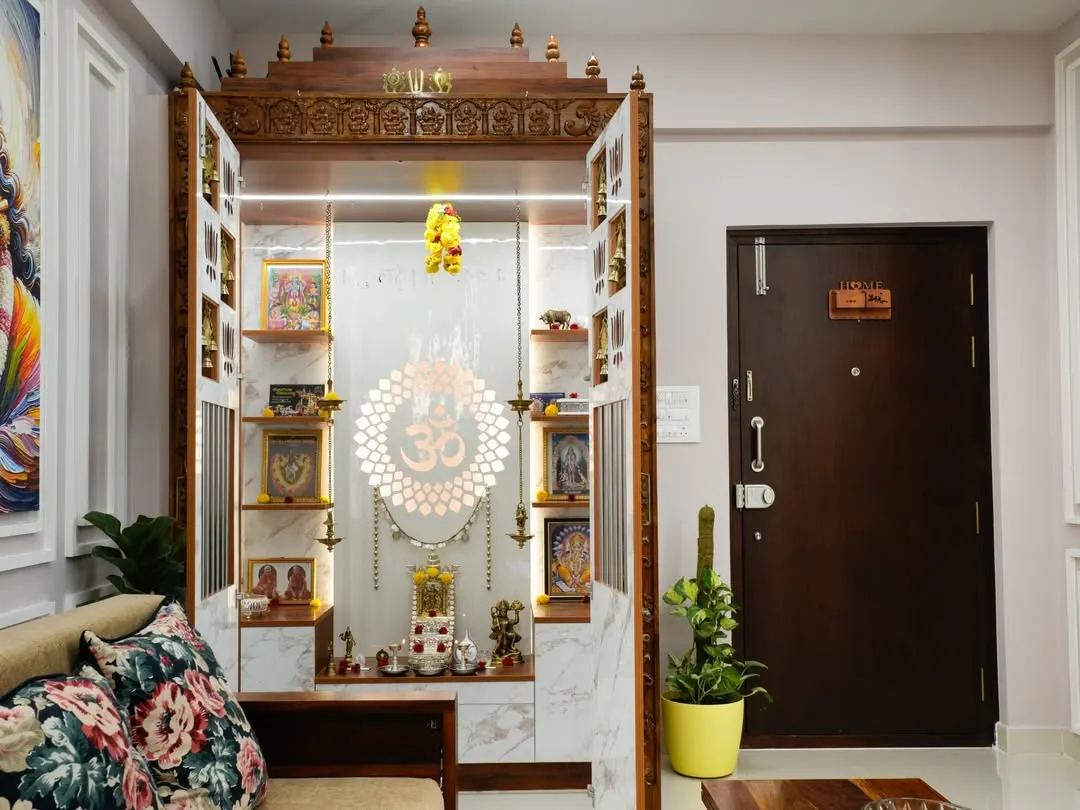
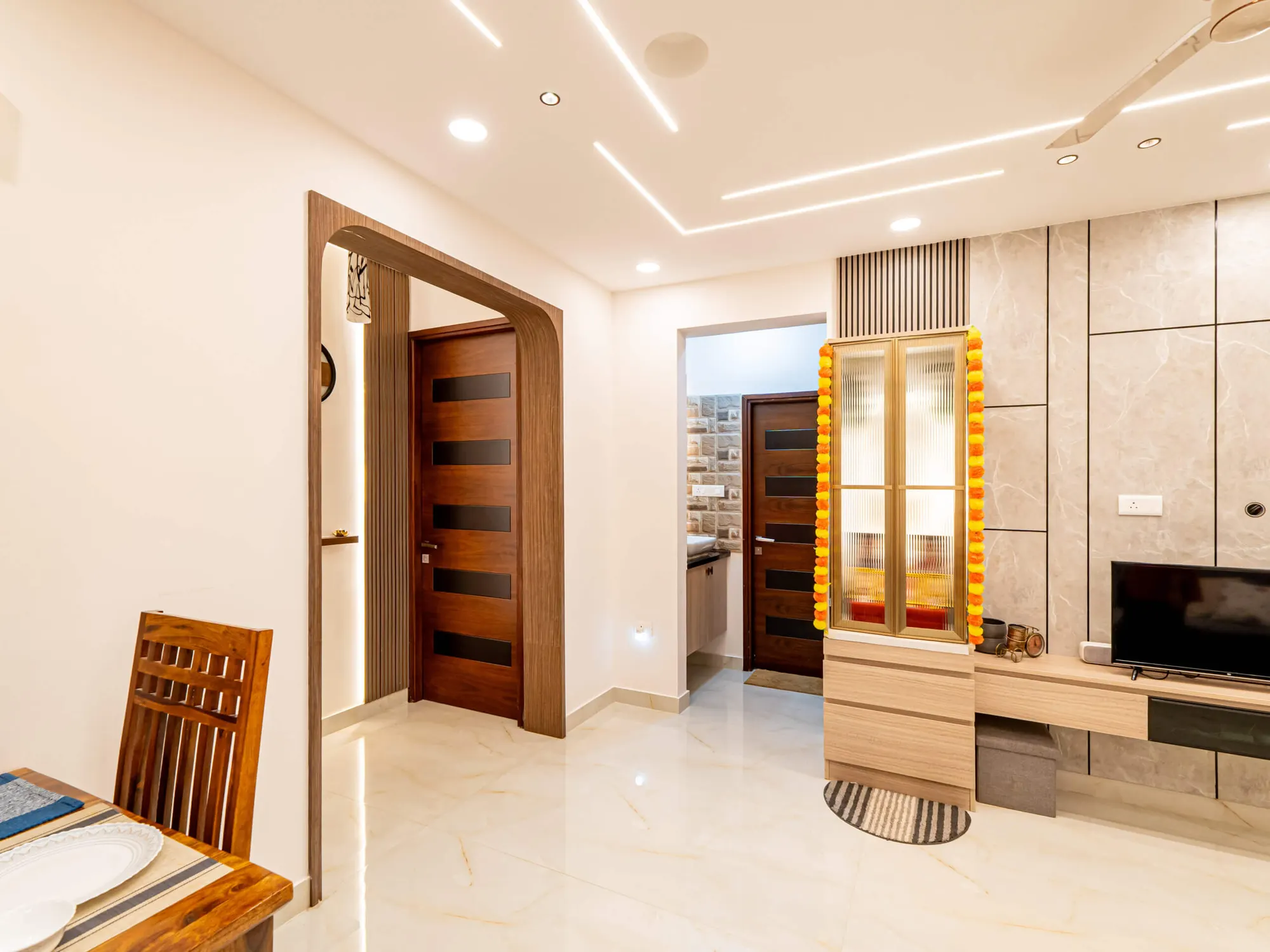
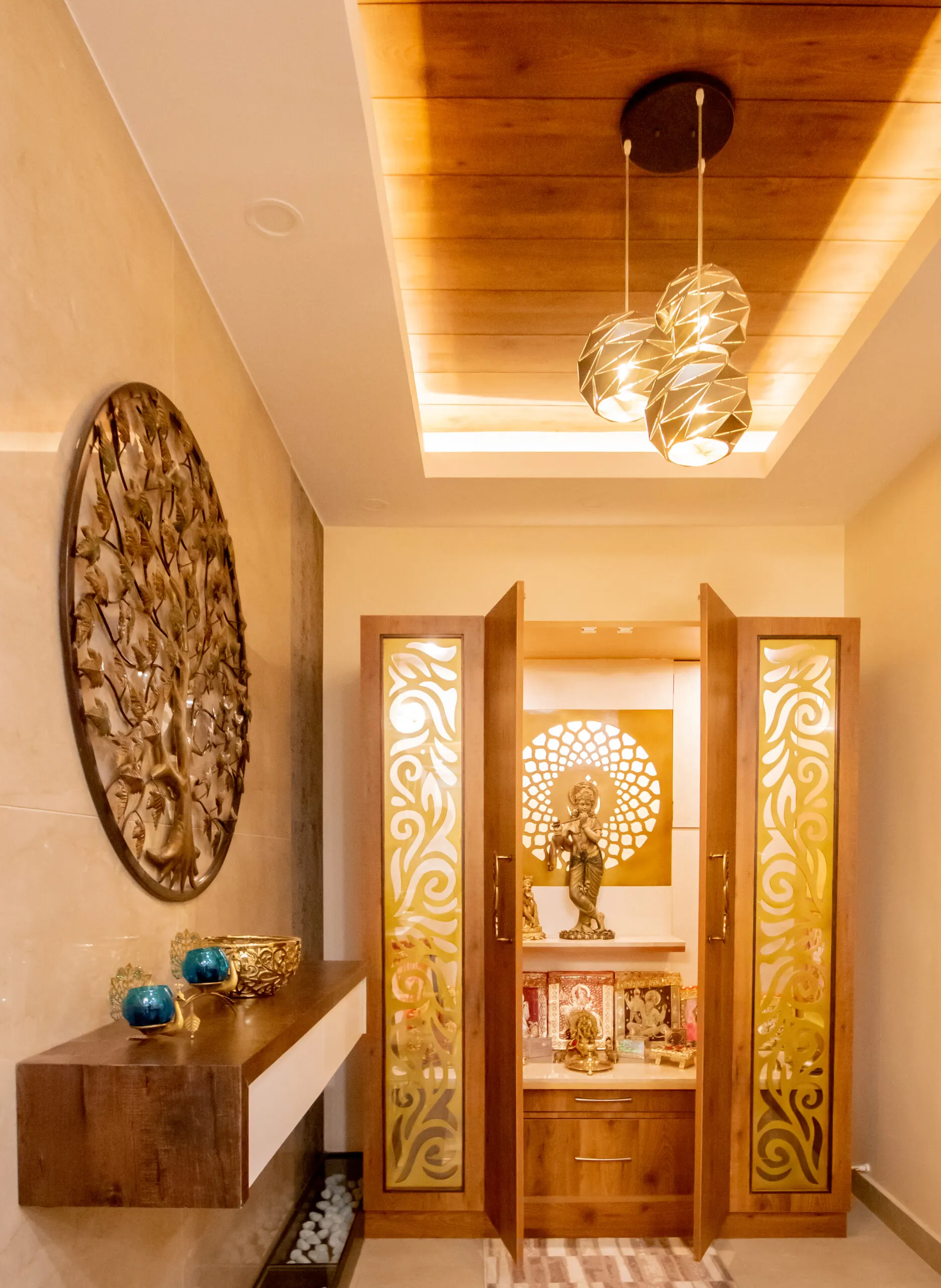
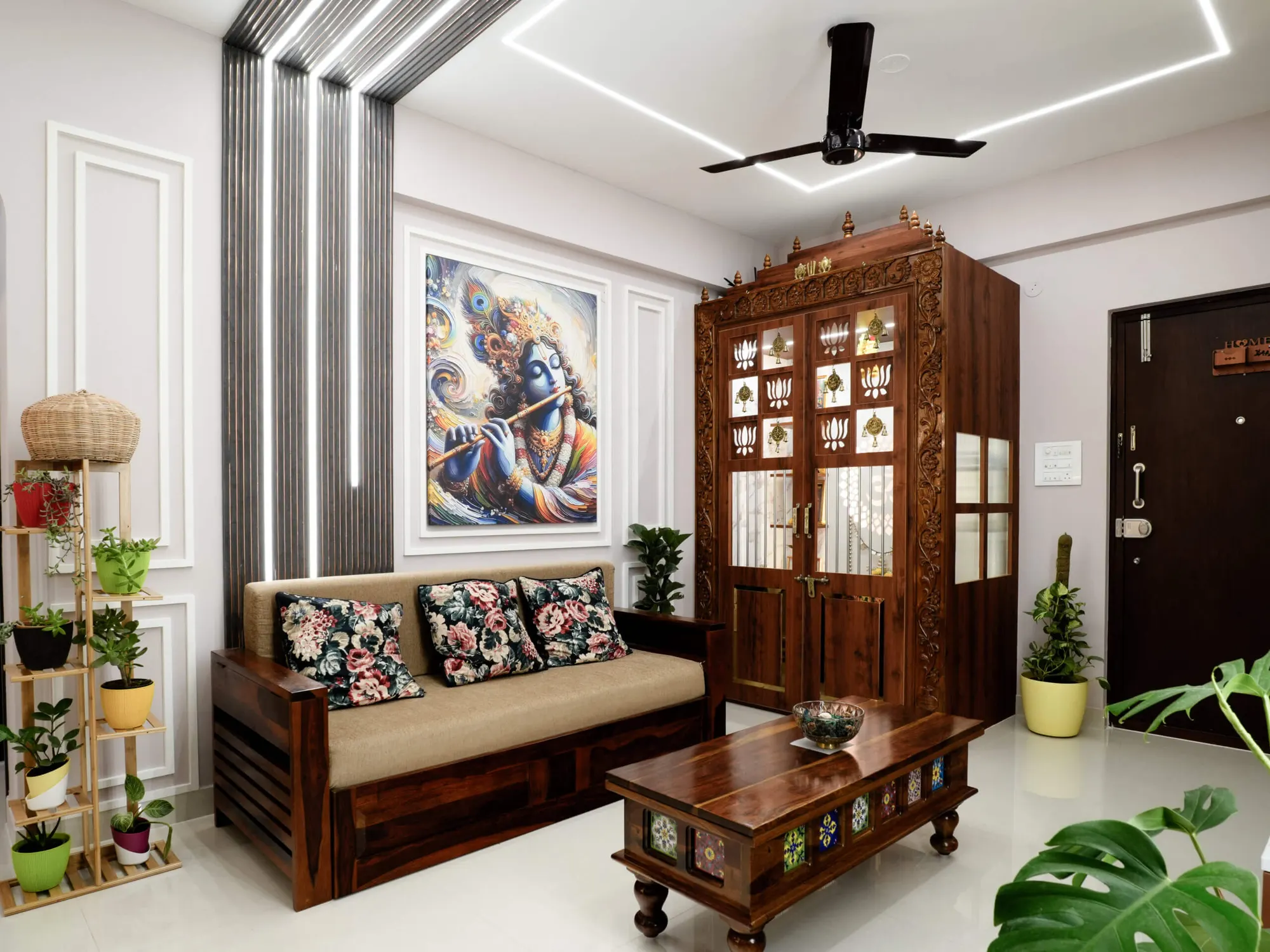
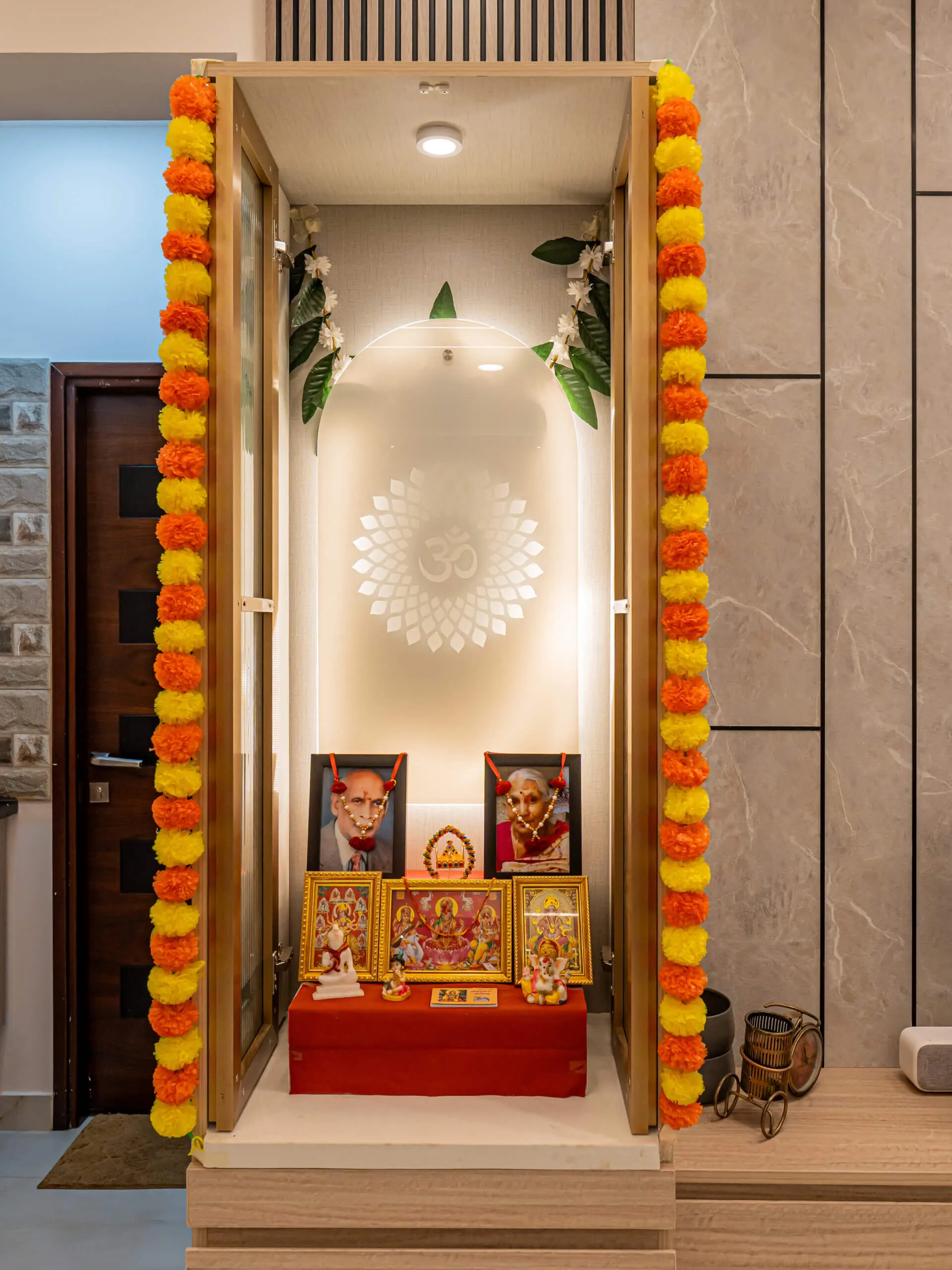
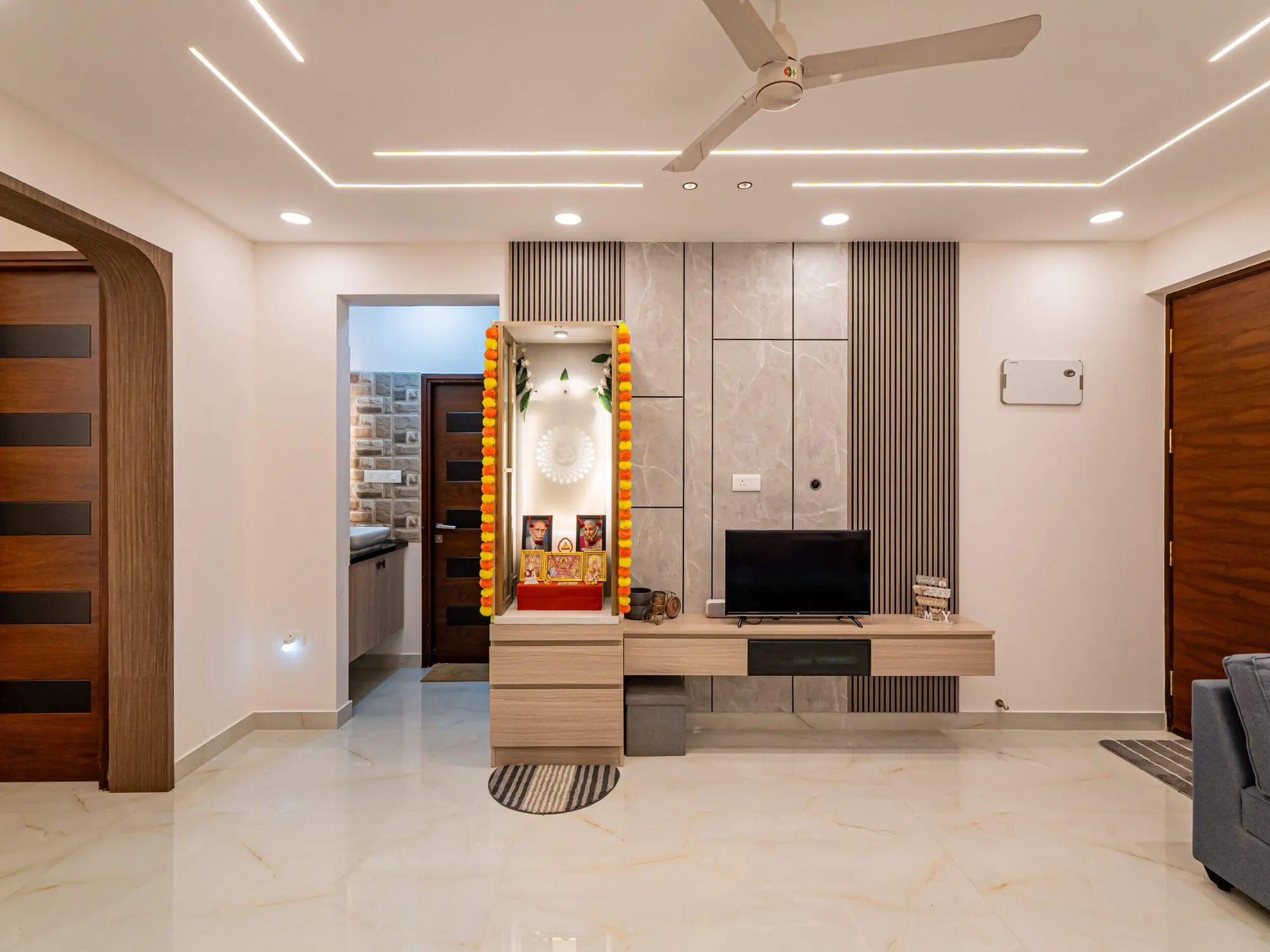
- Freestanding unit with doors: looks like a piece of furniture and closes when you want it to. The carved wooden cabinet in the gallery has glass shutters and a marble-look back panel with a backlit Om; another has fluted glass doors in a brass frame on an oak drawer base. Good when you have floor space and want storage below.
- Niche or alcove: recessed into a wall or a partition, so it takes almost nothing from the room. It works best when planned early, during the full home design, because the wall itself may change. Structural walls need care. If space is really tight, a corner unit or a shelf inside the TV unit with a sliding door still works.
A living-room wall is the usual spot, and a few places are avoided
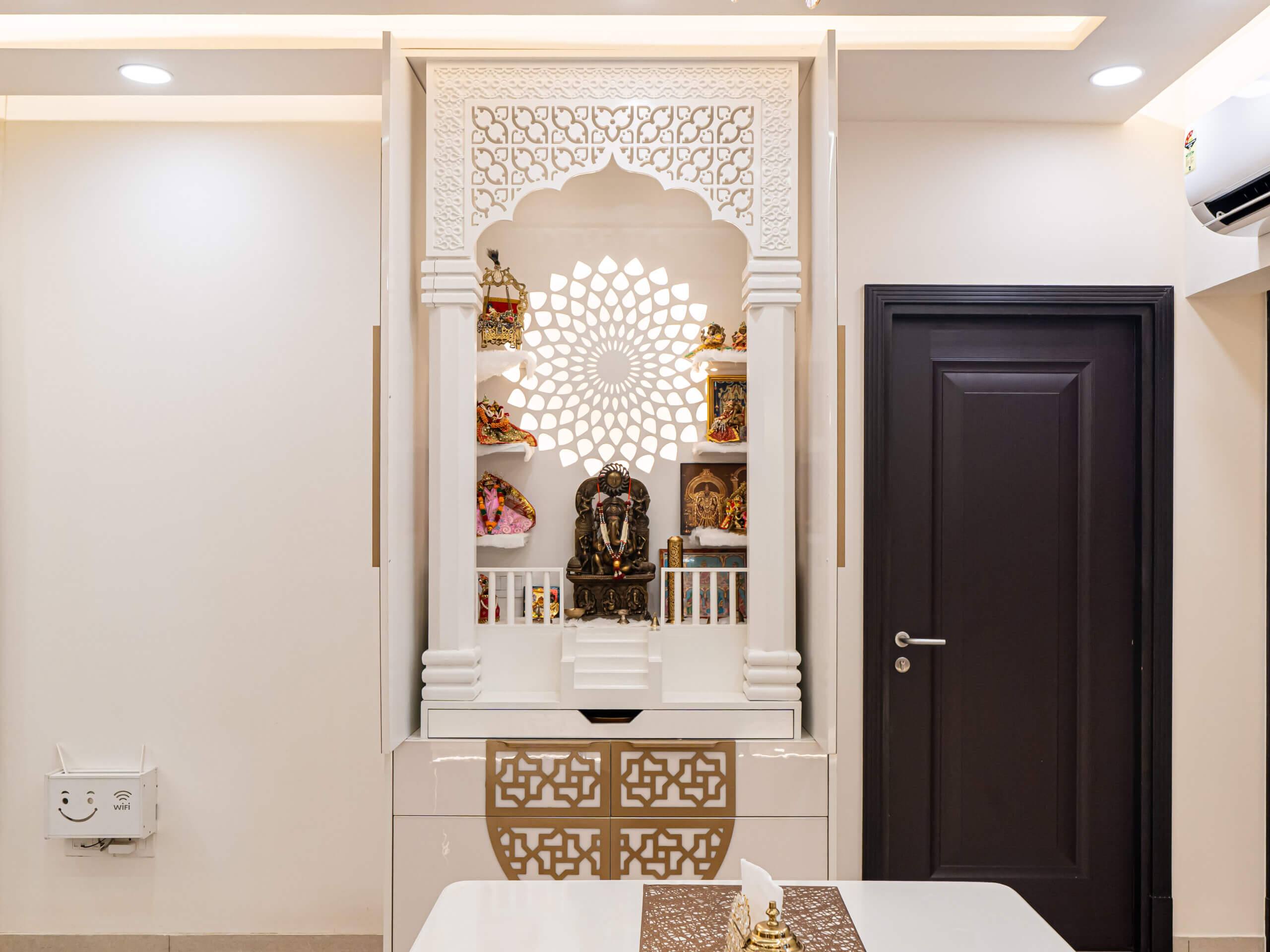
In a flat, a side wall of the living room is the most common choice: easy to reach, visible, and out of the walkway. We keep it off the TV wall and off any wall shared with a bathroom. A slim unit between the dining area and a passage works too, as long as chairs will not block it and there is standing room for aarti. The white jaali unit at Sobha Royal Pavilion sits beside the dining table, next to a door.
Many families want the northeast corner, facing east or north. If the floor plan allows it, that is where it goes. If not, we show you the best workable position in 3D and explain the trade-offs, and you can check with your family priest before anything is built.
Stone under the diya, ply in the body, jaali or glass in front
The body is BWR or BWP grade plywood, because Bangalore’s long monsoon makes ordinary wood swell, and the edges are sealed. Under the diya there is a marble or granite base, with a clear gap between the flame and anything wooden above it and heat-resistant finishes around it.
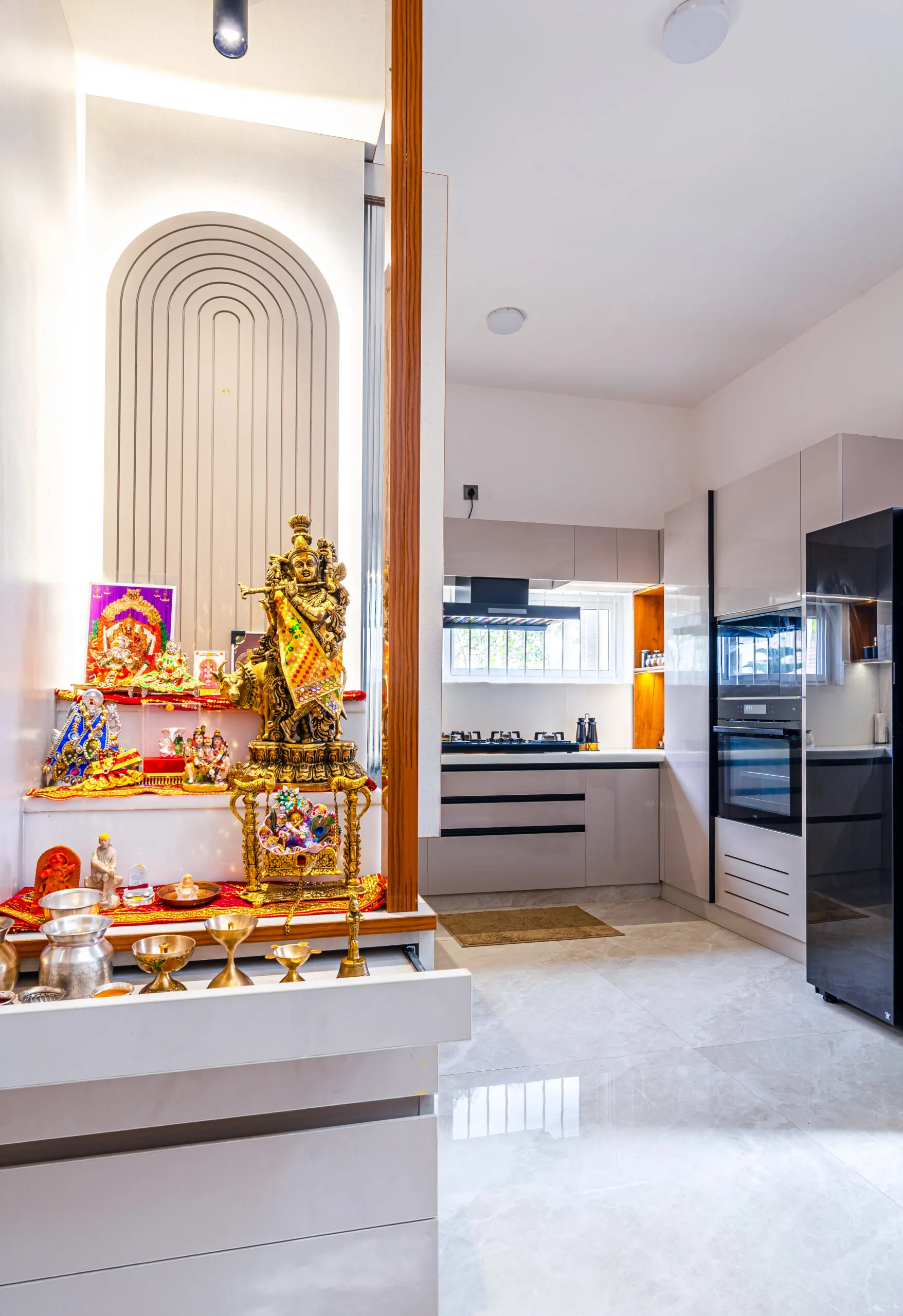
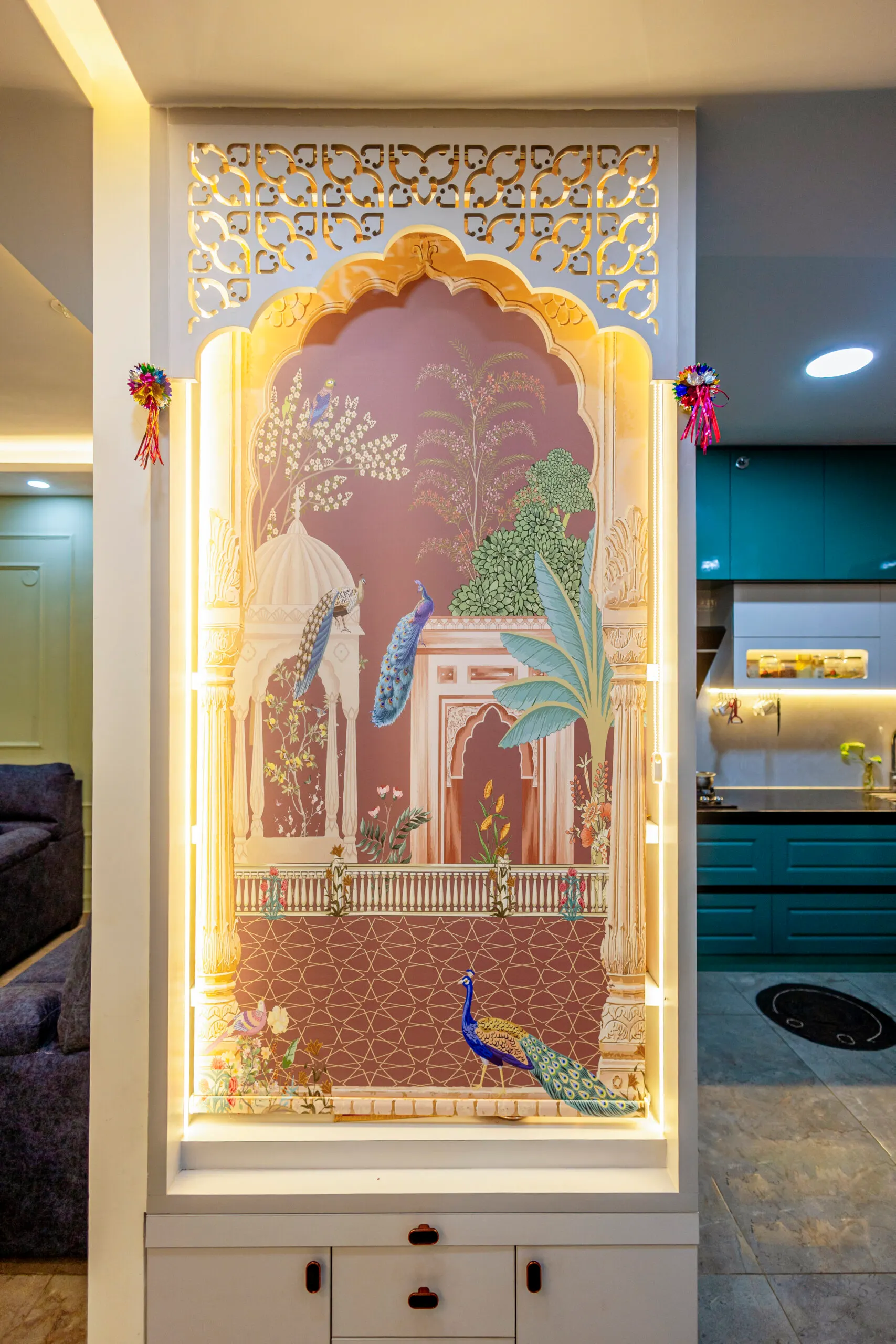
In front, the options are a CNC-cut jaali in white or gold, fluted or etched glass shutters, wooden louvres or bi-fold glass doors, and a backlit panel behind the idols: a mandala, an Om, a ribbed arch, or a painted mural like the peacock panel in the gallery. Finishes are matched to the rest of the home. Soft whites, warm woods and gold details suit a contemporary flat; very glossy surfaces are avoided because they glare under diya light.
Warm light from behind the idols, not a cool white from above
We use warm white LEDs in the 2700 to 3000 kelvin range: a backlit panel behind, a small spotlight on the idols, and in some units a lit ledge on each shelf. Cool white reads like an office. Where the unit has a nook of its own, the ceiling can carry it too: a wood-panelled false ceiling with cove light and three brass pendants over the wooden cabinet in the gallery.
Smoke, heavy idols and the clutter are planned for
Agarbatti and camphor smoke lingers in a closed cabinet, so the unit gets a ventilated top or jaali back. Marble idols and brass lamps are heavy, so shelves are supported properly and wall-mounted cabinets are fixed into solid wall, not plaster. Many Bangalore flats have lightweight internal walls, so we check first.
Pooja items multiply: oil, wicks, matches, incense, kumkum, haldi, books, festival decorations, spare idols. Deep drawers with dividers and a closed cabinet below keep all of it within reach and out of sight.
Two to four weeks, and before your festival date if you tell us early
At the site visit we measure the space and ask about your idols and your routine: do you light a diya every day, how many people pray together. You see the unit in 3D, pick finishes from real samples and get an itemised quote with materials, lighting and timeline in writing. Carpentry, stone work, jaali cutting and electrical work follow in order, and at handover we check every drawer, door and light with you.
A custom pooja unit usually takes two to four weeks from design approval. Families often want it ready for a housewarming, Ugadi, Ganesh Chaturthi, Navaratri or Diwali; tell us the date at the first call and we work backwards from it.
The work
Pooja units, as built.
8 photos · tap to enlarge
Homes with this work
See it in a finished home.
5 BHK villa, Jigani
5 BHK villa, Jigani · 39 photos
Prestige Shantiniketan
3 BHK apartment, Whitefield · 47 photos
Before you call
Questions people ask us
Which direction should the pooja unit face in a flat?
Many families prefer the northeast corner, with the person praying facing east or north. Apartment layouts are fixed, so if that corner does not work we find the best workable spot and explain the trade-offs. If your family follows specific traditions, check with your priest or Vastu consultant before we finalise.
How much space does a pooja corner need?
A compact wall-mounted cabinet works in roughly two feet of width. What matters more is standing room in front for aarti, so we keep it off busy paths and away from dining chairs.
Can the pooja unit go in the bedroom?
Yes, if there is no better option in a 1 BHK or a very compact flat. Choose a unit with doors or a curtain so it can be closed, and place it away from the foot of the bed. We avoid the kitchen stove and walls shared with a bathroom.
What happens to the incense smoke?
A closed cabinet traps it, so we plan a ventilated top or a jaali back. If your flat has smoke detectors we keep the unit away from them and check your society's rules on open flame.
How long does it take?
About two to four weeks from design approval to installation, depending on the format and finishes. If the pooja unit is part of a full home, it follows the overall schedule of 45 to 60 working days.
Often done together
Related services
Tell us about your home.
A site visit, a 3D design and an itemised estimate, free. Most homes are handed over in 45 to 60 working days.