
Journal · 26 October 2026 · 8 min read
Moisture-resistant materials for Bangalore homes
Which boards, finishes, paints, floors and hardware hold up through Bangalore's long monsoon, room by room, and what to ask a designer before you sign.
You move into your new flat in Haralur. The paint is fresh, the wardrobes look sharp, and then June arrives. Within three weeks the bottom shelf of the bedroom wardrobe smells musty, a dark patch spreads behind the sofa wall, and the kitchen drawers stop closing properly. We hear this story often, and it is almost always avoidable.
If you are meeting interior designers for the first time, one question belongs right next to budget and style: what will this home look like after five monsoons? This post covers the materials, the rooms, the process and the questions that decide the answer.
Why the monsoon comes before colours and layouts
Most people choose interiors in dry weather. You visit showrooms in February, pick glossy laminates under bright lights and sign off on a design that looks perfect on a sample board. Nobody tests it against a wet July in Bellandur.
A good designer flips that order. Before talking about colours and layouts, we ask where moisture will enter, where it will settle, and which parts of the home cannot afford to swell, warp or grow mould. That one habit changes almost every material decision that follows, for three reasons.
- Moisture damage is slow, then sudden. Wood-based boards absorb humidity quietly for months. You see nothing until edges lift, hinges loosen and surfaces bubble. By then the repair usually means replacing the whole unit.
- Repairs cost more than prevention. Replacing a swollen kitchen base cabinet costs far more than choosing a better board at the start. The extra spend on the right material is small next to redoing work in your second or third year.
- Your health is involved. Damp cupboards and walls encourage mould, and mould triggers allergies and breathing trouble, especially for children and older family members.
So when you compare designers, do not only look at how finished homes appear on day one. Ask how they have handled moisture, and ask to see older projects.
What is different about Bangalore
Bangalore is not Mumbai or Kochi, and the usual coastal advice does not fit perfectly. The city has its own pattern.
The weather
Bangalore’s monsoon is long rather than violent. Rain arrives in June, then returns in September and October with the northeast monsoon. Between those spells the air stays cool and heavy with humidity. Homes on lower floors, homes near lakes or open drains, and flats in Bellandur and Haralur that sit close to water bodies feel this the most.
The problem is not only rain. It is the constant dampness in the air, which wood absorbs in small amounts every day. Closed wardrobes, shoe cabinets and under-sink storage are the usual victims, because air cannot move through them.
Apartment rules
Most new homes on Sarjapur Road, in Whitefield and in HSR Layout are apartments, and apartments come with rules that shape the design.
- Working hours. Many associations allow noisy work only during fixed hours, often on weekdays. Drilling, cutting and hammering are restricted, which affects how the project is scheduled.
- Lifts and material movement. Goods lifts need to be booked, and large panels may have to be cut on site or carried up the stairs.
- Wet-area changes. Moving a bathroom, shifting a kitchen sink point or breaking floor tiles usually needs permission, because waterproofing and drainage belong to the building.
- Balcony and facade rules. Some societies do not allow changes to balcony enclosures or external grills, so your monsoon protection has to work within what is permitted.
- Deposits and damage. Associations often take a refundable deposit and hold you responsible for damage to common areas.
A designer who has worked in apartments across Bangalore checks these rules before drawing a line.
Space
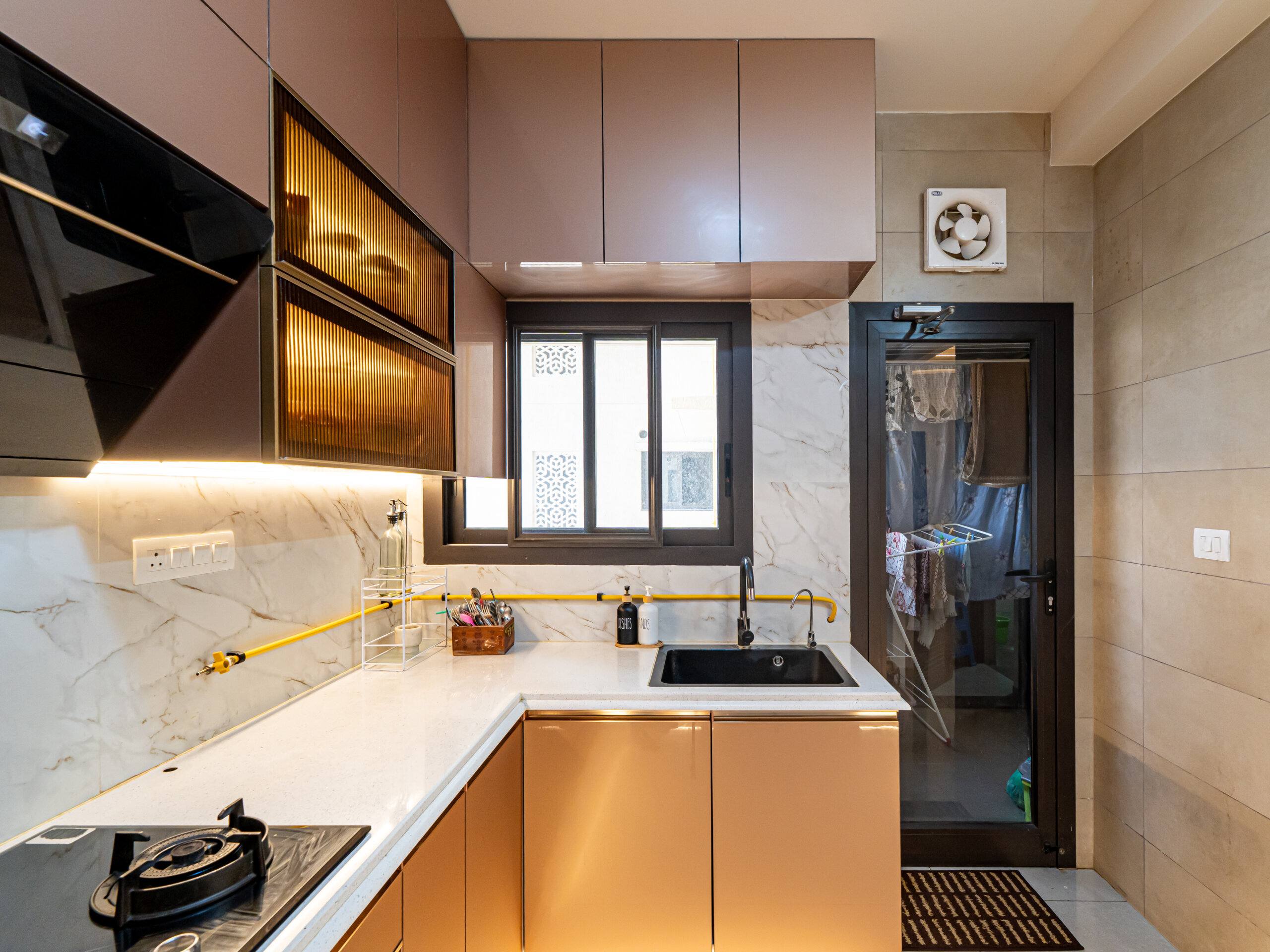
Many 2 and 3 BHK flats have compact kitchens, small utility areas and balconies that double as laundry spots. Wet clothes drying indoors during the monsoon add a lot of moisture to a small space. Good planning gives you a ventilation path, a drying spot near the balcony, and enough breathing room behind storage units for air to move. The kitchen in the photo above does this with a window over the sink, an exhaust fan above the door, and a glass door to a utility passage where the clothes hang.
Boards and plywood
This is the heart of the interiors, so it is the most important choice. One rule covers most of it: the closer a unit is to water, the better the core board must be.
- Boiling-water-proof plywood is the safest option for kitchens, bathroom vanities and any unit near water. It uses a stronger glue that resists swelling when wet. It costs more than ordinary plywood, but it is the best value where moisture is a real risk.
- Marine-grade plywood is the strongest choice for direct water contact, such as under the sink. It is more than most bedrooms need, so we use it selectively.
- High-density, high-moisture-resistant board is a sensible choice for wardrobes and shelves in dry rooms. It handles humidity far better than medium-density fibreboard and usually costs less than plywood.
- Plain MDF and particle board are the ones to be careful about. They swell quickly when damp. We avoid them in kitchens and bathrooms and only suggest them for decorative panels in dry areas where nothing touches water.
Laminates, veneers and edges
The surface protects the board underneath, but only if the edges are sealed properly. Water enters through edges and cut holes, not through the flat face.
- High-pressure laminates give a hard, water-resistant surface for kitchen shutters and wardrobe fronts.
- Acrylic and polyurethane finishes are glossy, easy to wipe and good at keeping humidity out.
- Edge banding needs the most attention. Thick, well-glued edge strips stop moisture creeping in. Ask how edges are sealed, and check them during site visits.
- Natural veneers look lovely but need a good protective coat in a monsoon-prone home. We seal them well and keep them away from wet zones.
Paint, walls and floors
Walls take the longest to show dampness and are the hardest to fix later.
- Use waterproof primer and damp-resistant paint on external walls and on walls that adjoin bathrooms.
- Choose antifungal, washable emulsions in bedrooms and living rooms, particularly on lower floors.
- Treat any existing seepage before painting. Paint on a damp wall only hides the problem for a few months.
- Consider textured or tiled panels behind kitchen counters and wash areas, where splashes are constant.
For floors, vitrified and ceramic tiles hold up well in kitchens, bathrooms and balconies; pick anti-skid finishes for wet areas. Engineered wood and laminate flooring look warm, but only with a proper moisture barrier underneath, and they are better in upper-floor homes. Natural stone works but must be sealed regularly. Wood-plastic composite and PVC are strong choices for balconies and utility areas, since they do not rot or swell.
Hardware and fittings
Tiny parts decide how long a cabinet lasts. Plain iron screws and hinges rust in humid weather and stain the board around them. We prefer stainless steel or coated hardware for kitchens, bathrooms and balconies. Soft-close channels with sealed bearings also last longer than cheap ones.
Room by room
Kitchen. Boiling-water-proof plywood for base cabinets, a waterproof strip along the bottom of every unit, stainless steel or coated hardware, and a chimney that actually vents outside.
Wardrobes and bedrooms. High-moisture-resistant board or plywood, small ventilation gaps, and a back panel with a moisture barrier if the wardrobe sits on an external wall.
Living room and balcony. Keep sofas and wooden furniture a few inches away from external walls. Use balcony-friendly materials such as composite decking and treated metal, and plan a covered or ventilated spot for drying clothes.
How the project runs
Our studio is at Sarjapura, off Varthur Road, and we work with families across the city, from Whitefield and HSR Layout to Bellandur and Haralur. After over fifteen years here we have a fair idea of what holds up in Bangalore’s weather. A typical home takes 45 to 60 working days, and the work usually runs in this order.
- First conversation. Your family, your daily routine, budget and timeline. We also ask about the building, the floor and any known seepage.
- Site visit and measurement. We check walls, bathrooms, balconies and windows for damp signs and measure every room.
- Concept and layout. Layouts, material suggestions and mood boards, with the reason for each material spelt out, especially in wet zones.
- Quotation and samples. An itemised quote, and physical samples so you can touch and compare finishes.
- Design finalisation. Drawings, 3D views and electrical and plumbing points are confirmed before work begins.
- Execution. Civil, carpentry, electrical and painting work run in a planned order, within your apartment’s working hours and lift rules.
- Quality checks. Waterproofing is tested, edge sealing checked and hardware inspected before handover.
- Handover. A walkthrough, care instructions for the monsoon months, and one point of contact for follow-up. You deal with one person from the first call to handover, not five.
Questions to ask before you hire
These help you separate talk from experience.
- Which boards do you use for kitchens, bathrooms and wardrobes, and why?
- How do you seal edges and cut holes against moisture?
- Can I see photos of, or visit, a home you finished at least two years ago?
- Who tests waterproofing, and is it done before the interiors begin?
- Does your quote name the exact materials, thicknesses and brands?
- How do you handle apartment rules, lift booking and working hours?
- What does your warranty cover, and what is excluded?
- Who is my single point of contact during the project?
- What is the payment schedule, and what happens if the timeline slips?
Pay attention to how they answer. A designer who has dealt with damp homes speaks in specifics. One who has not drifts into general talk about style.
Common questions
Which plywood is best for Bangalore’s humid weather?
Boiling-water-proof plywood is the best all-round choice for kitchens, vanities and wet areas. For dry rooms, high-density, high-moisture-resistant board is a sensible, budget-friendly option.
Can a ground-floor flat have moisture-resistant interiors?
Yes. Ground-floor and lake-facing homes need extra care: a waterproof barrier behind storage, raised plinths and better ventilation. It costs a little more and protects the work.
Do you work across all of Bangalore?
Yes. The studio is at Sarjapura and we take on projects across the city, including Whitefield, HSR Layout, Bellandur and Haralur.
After the rains
A good interior is not only about how it looks on handover day. It is about how it feels in the middle of a wet September, and how it holds up three years later. Choose the right boards, seal the right edges, waterproof the right corners, and the home repays you quietly for years. If you are planning your interiors, get in touch and we will start with the site visit.
Tell us about your home.
A site visit, a 3D design and an itemised estimate, free. Most homes are handed over in 45 to 60 working days.